
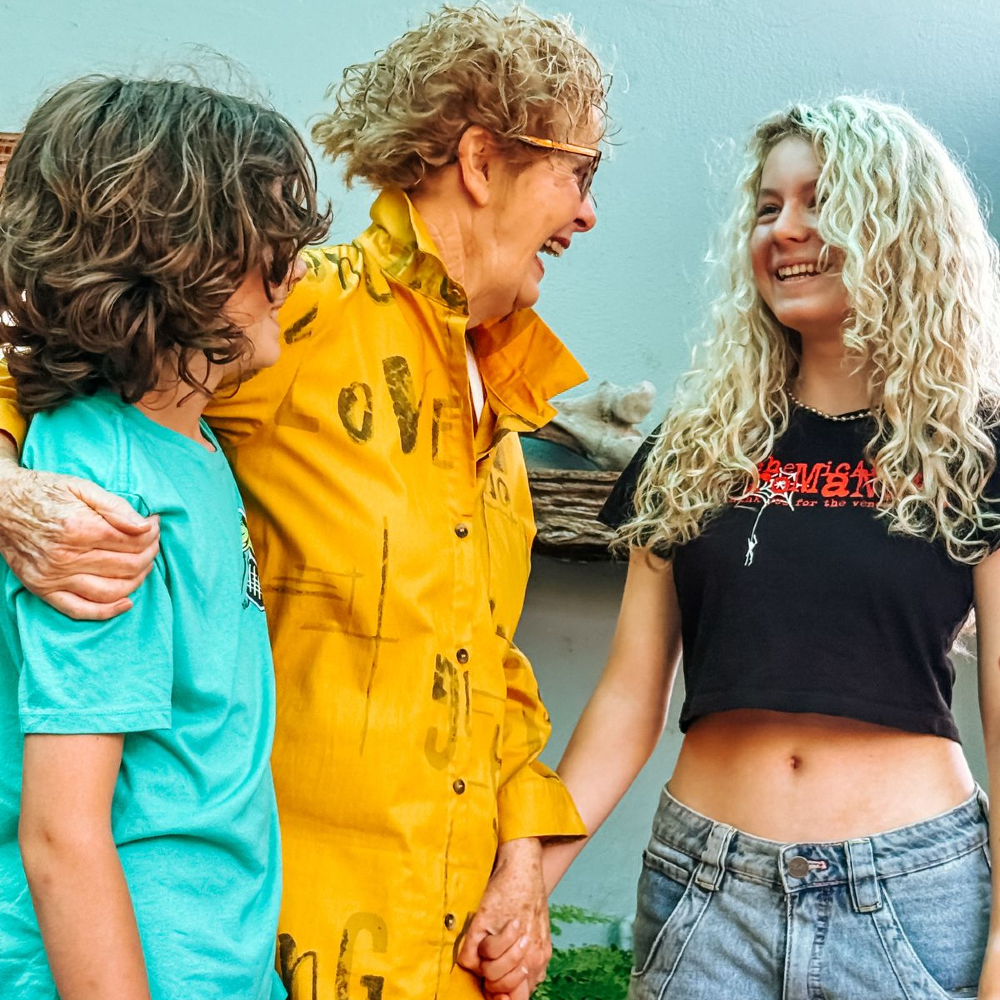
Mary Elizabeth Dugmore Obituary
Port Elizabeth, Eastern Cape, South Africa
April 18, 1949 - March 16, 2026
Mary Elizabeth Dugmore Obituary
Apr 18, 1949 - Mar 16, 2026
Liz Dugmore, a Titan of Spirit, dies at 76.
In the cool of Monday morning, March 16, 2026, Liz Dugmore lay beside her loving husband, Neville, and took her last breaths. She died at home in Port Elizabeth, gently drifting through the veil while sharing memories of her sons. A pioneering flame flickered once more, then folded into stillness. That particular light, a light so full of love, understanding, wit, and spiritual force, passed from this world into the next, where those who loved her imagine her reunited with her precious mother, Mary.
Liz Dugmore was born Mary Elizabeth Barrow on April 18, 1949, in Wallasey, Cheshire, to Douglas Barrow and Mary Barrow, née Devlin. She was, from the beginning, one of those people whose life would not be adequately described by chronology alone. The facts matter, of course. She was a daughter, a wife, a mother, a hairdresser, a businesswoman, a spiritual seeker, a teacher, an author. But these titles, though true, do not quite capture the voltage of her presence. Liz did not merely move through the world. She interpreted it, challenged it, transfigured it, and, for many, illuminated it.
She began her working life in Liverpool as a 16-year old apprentice hairdresser, which was, for her, not a modest beginning but a profound apprenticeship in human nature. Hairdressing, in lesser hands, is a trade. In hers, it became a form of intimate ministry. She listened to people very, very closely. She had that rare gift of attention that makes another person feel not merely heard, but revealed to themselves. She understood long before the language of therapy became fashionable that people often arrive with one story and leave having told another.
She married her childhood sweetheart, David Fenton, and together they began the first great chapter of her adult life. Family lore preserves the moment of emigration with the kind of comic precision that destiny sometimes borrows. On a miserably rainy day in Merseyside, a gust of wind turned her umbrella inside out, exposing her newly arranged hair to the weather. Furious, she swore, hurled the umbrella into a rubbish bin, and looked up to see a travel agent’s window bearing the words: “South Africa, the land of sunshine and opportunity.” For another person, it might have been a passing irritation, then a forgotten slogan. For Liz, it was a summons. She went home and announced that they were moving to South Africa.
They built a life on the East Rand of Johannesburg, where the sunshine was real and, for a while, so was the promise. There she became a mother to her two sons, Devlin and Daniel Fenton, whom she loved with the ferocity and tenderness that would remain the organizing principle of her life. Motherhood did not soften her so much as deepen her. She was never slight in spirit, but becoming a mother enlarged her sense of purpose.
Like many lives of consequence, hers was not spared disruption. The marriage ended gently in memory but painfully in fact, and there followed a difficult interval in which she returned to England for nine months with her boys. Then, in 1984, she did what would become one of the defining acts of her life: she returned to South Africa and began again, this time in Port Elizabeth, carrying with her two suitcases, her two boys, and a will of astonishing tensile strength.
The mythology of reinvention often omits the labor. Liz’s did not. She built her life the hard way: increment by increment, client by client, day by day. She ran a thriving hairdressing practice six days a week, often from dawn until dusk. From Walmer Caravan Park to a flat in Walmer Gardens, and eventually to the lovely home on Prospect, she earned every inch of stability. She was the consummate entrepreneur not because she worshipped business, but because she understood survival, dignity, and independence. She built a successful business while raising two boys and managing the thousand invisible demands of life with remarkable stamina and style.
Yet she was never alone in the work. Liz attracted community the way warmth draws people toward a fire. Around her gathered kind souls who helped, guided, fed, steadied, and loved. Some became honorary aunts and uncles, grannies and grampas, figures of chosen kinship for her boys. She spoke of those years not chiefly as years of struggle, though they were that, but as years of meaning. She had found her purpose. She had her sons close. She had work that mattered. She had, in the midst of uncertainty, an unmistakable sense of vocation. These were some of the happiest years of her life.
In those early Port Elizabeth years, the Association of Creative Thought entered her life. It was there that her already formidable interior life found structure, discipline, and fellowship. June Jones, Rosemary Batchellor, Helen Penfold, and Mallory Kretzman were among the great women who shaped that chapter—women of conviction, spiritual seriousness, and immense force. Under June Jones’s exacting guidance, Liz undertook years of study and transformation, eventually becoming an ordained minister, a role, perhaps, Liz’s Johannesburg mentor, Dr. Reg Barret, might have had a vision of.
And yet ordination, though significant, was not the terminus of her calling. It was more like a gate.
Her path moved further out, into stranger and older territory. With Helen Palmer and David Daniels as guides, Liz encountered the Enneagram and recognized in it not a fad, not a typology for cocktail-party self-description, but a living map of the soul. Here was a language capacious enough to hold religion, psychology, behavior, cosmology, mathematics, symbology, and spiritual hunger in one frame. For Liz, this was not merely interesting. It was revolutionary.
She approached these studies with the fearlessness that defined her best work. She was willing to be vulnerable, to examine herself unsparingly, to descend into the dark and hidden chambers of the psyche and return with light. She had no patience for shallow revelation. She wanted the root system, the subterranean architecture, the occulted pattern beneath appearances. Her learning became deep, arcane, and—in the oldest, least sensational sense of the word—occult: concerned with what is hidden, ancient, and spiritually consequential. She was not content to inherit wisdom passively; she labored to bring it through herself and into language that others could use.
Naturally, she began to teach.
What she learned, she shared. What she saw, she translated. Her knowledge became coursework, teaching materials, conversations, diagrams, and living encounters. Liz became an internationally recognized expert in her domain, not because she sought acclaim in any vulgar sense, but because her understanding was original, embodied, and alive. She was helping define a modern language for an ancient system even as it re-emerged in contemporary consciousness. She was not simply repeating doctrine. She was participating in revelation.
That body of work eventually demanded books. Among her writings were “Through the Squint Window” and “The Space in-between the Story: Enneagram: 9 Interior Landscapes”, as well as other written works that extended her teaching and preserved her insights. These books, like her life, were invitations into deeper seeing. They asked readers not only to understand themselves, but to bear the unsettling and liberating experience of being understood.
Through all of this - the salon, the sons, the spiritual studies, the teaching, the writing - Liz remained gloriously herself: bright-eyed, fairy-loving, exacting, generous, irreverent, mystical, practical, and utterly incapable of being reduced to one role. She traversed barriers between cultures, creeds, religions, languages, faiths, and generations with astonishing ease. She could speak to the wounded, the eccentric, the skeptical, the devout, the brokenhearted, and the intellectually hungry. She was, in the truest sense, a spiritual titan, though she wore that stature with the earthy humor and matter-of-fact resilience of a woman who had also spent years earning a living on her feet.
In the later chapter of her life, she found enduring love and companionship with Neville Dugmore, who stood beside her not only as husband but as witness. It was with him, at home, that she passed from this life, peacefully, intimately, and still speaking of the sons who had always been at the center of her heart.
She is survived by her husband, Neville Dugmore, and by her two sons, Devlin and Daniel Fenton.
What a life she lived. Not tidy. Not small. Not ordinary. A life of grit and radiance; of commerce and spirit; of collapse and rebuilding; of old wisdom and modern language; of motherhood, ministry, authorship, and love. Liz Dugmore answered the call more than once. First to cross an ocean. Then to raise her boys. Then to build a business. Then to descend into the interior landscapes of the soul and return with maps for others.
She leaves behind not only memories, but orientation. Not only grief, but instruction. Not only love, but light.



Guestbook